H.R. PLASTIC MACHINERY PVT. LTD.
PVC Mixture Machine in Ahmedabad
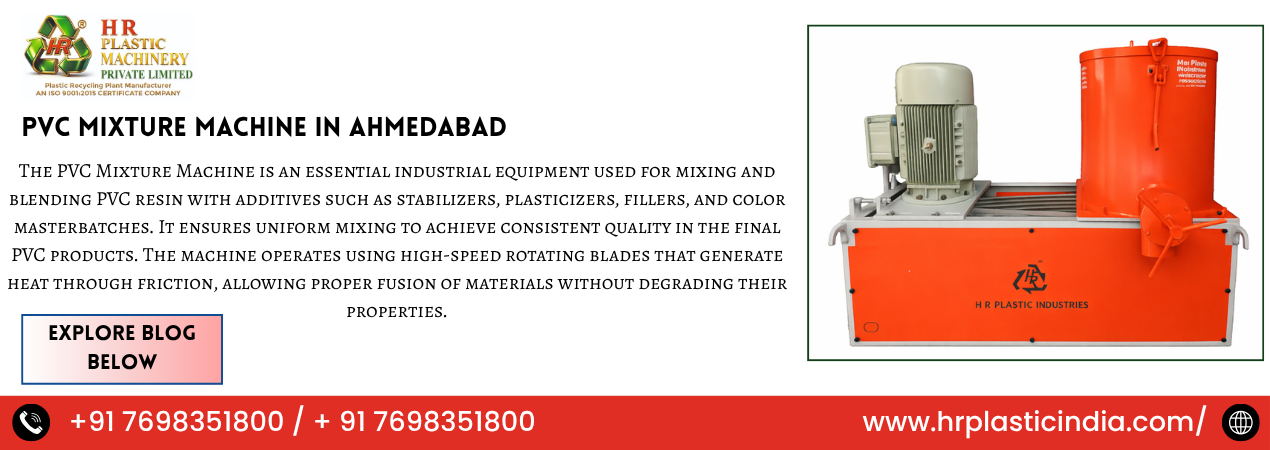
PVC Mixture Machine in Ahmedabad
PVC Mixture Machine in Ahmedabad | HR Plastic Industries Private Limited
PVC Mixture Machine
Company Address: 35, Shivalik Industrial Park, Nr. Amba Hotel, Chowkadi, Near Kuha Gam, Ahmedabad to Indor Highway, Ahmedabad-382433. Email [email protected] Phone +91 7698351800
Plastic Processing Machinery
PVC Mixture Machine
in Ahmedabad
Ahmedabad is one of India's important industrial centers for plastic processing machinery, PVC product manufacturing, recycling equipment, extrusion systems, and polymer-based production units. With steady demand from pipe manufacturers, cable insulation units, profile makers, sheet producers, plastic compounders, and recycling plants, the need for reliable PVC mixing equipment has continued to grow across the region.
Overview
PVC Mixture Machine in Ahmedabad
A PVC Mixture Machine in Ahmedabad plays an important role in helping manufacturers prepare uniform PVC compounds before extrusion, molding, calendaring, or further processing.
A PVC mixture machine is used to blend PVC resin with stabilizers, plasticizers, fillers, color masterbatches, lubricants, and other additives. Its purpose is not limited to simple mixing. The machine also supports controlled heat generation, proper material conditioning, and consistent compound preparation. In PVC processing, poor mixing can lead to uneven product quality, color variation, weak mechanical performance, improper flow behavior, and production rejection. For this reason, manufacturers prefer equipment that can deliver controlled mixing, stable temperature handling, and uniform material distribution.
H.R. Plastic Industries Private Limited is associated with plastic processing machinery and custom plastic fabrication solutions. The company works with equipment used in plastic recycling, dana making, extrusion, grinding, washing, mixing, agglomeration, and related production systems. Its PVC Mixture Machine is designed for industrial applications where consistent blending, fast processing, durable construction, and practical operation are important for daily production requirements.
Role & Function
Understanding the Role of a PVC Mixture Machine
A PVC mixture machine is an essential part of PVC compound preparation. Before PVC material can be shaped into pipes, profiles, sheets, fittings, cable insulation, or packaging-related products, the raw material must be blended accurately with the required additives. Each additive has a specific role. Stabilizers help protect the material during heating, plasticizers improve flexibility, fillers support strength and cost efficiency, and masterbatches help maintain color consistency.
The mixing process must be uniform because PVC is sensitive to heat and processing conditions. If the material is not mixed properly, some parts may receive excess additives while others remain under-processed. This can affect extrusion quality, product surface finish, and final performance. A properly designed PVC mixer machine helps maintain consistency through high-speed rotating blades and a specially designed mixing chamber.
During operation, the blades rotate at high speed and generate heat through friction. This heat supports proper blending and early-stage conditioning of the PVC compound. At the same time, the machine must prevent overheating because excessive heat can affect material stability. Modern PVC mixture machines are therefore designed with temperature controls, time controls, discharge systems, and cooling arrangements to support safe and efficient material preparation.
Market Demand
PVC Mixture Machine Demand in Ahmedabad
Ahmedabad has a strong base of plastic processing industries, especially in areas related to extrusion, recycling, packaging, construction materials, pipe manufacturing, and polymer processing. Many businesses in and around Ahmedabad require machines that can handle continuous industrial workloads while maintaining production consistency. This makes the PVC mixture machine a practical requirement for units involved in PVC product manufacturing.
The demand in Ahmedabad is also connected to the growth of infrastructure, agriculture, electrical, packaging, and construction sectors. PVC pipes, fittings, sheets, profiles, insulation materials, and panels are widely used across these industries. To manufacture these products with consistent quality, manufacturers need properly mixed raw material before it enters extrusion or molding equipment.
For local manufacturers, choosing a PVC mixture machine in Ahmedabad also supports easier communication, service coordination, technical discussion, and machine selection based on actual production needs. Instead of treating the machine as a general mixer, buyers usually evaluate its chamber design, motor capacity, blade quality, control system, discharge method, heating behavior, and compatibility with their PVC formulation.
Working Principle
How PVC Mixture Machine Works
A PVC mixture machine works through a controlled mechanical mixing process. Raw PVC resin and additives are loaded into the mixing chamber according to the required formulation. Once the machine starts, high-speed blades rotate inside the chamber and create strong material movement. This movement helps distribute powders, fillers, pigments, and additives evenly throughout the batch.
As the blades rotate, frictional heat is generated. This heat helps soften and condition the PVC compound without the need for direct external heating in many cases. The machine's temperature and timing system helps operators control the mixing cycle so the material reaches the required processing condition.
After proper mixing, the material is discharged smoothly through the machine's discharge mechanism. In systems with an integrated cooling arrangement, the material temperature is reduced quickly after the hot mixing stage. This helps prevent over-processing, reduces the chance of material degradation, and supports stable compound quality before further processing.
Technical Aspects
Important Technical Aspects of PVC Mixing Equipment
When selecting a PVC mixture machine, manufacturers should look beyond only machine size. Actual performance depends on how well the system handles mixing uniformity, heat control, discharge speed, material flow, and long-term operation. A strong motor, balanced blade design, durable mixing chamber, and reliable controls are important for stable output.
Available models such as HRPIM - 24 x 28, HRPIM - 30 x 32, and HRPIM - 42 x 46 indicate that different sizes can be selected based on batch capacity and production requirements. A small or medium production unit may need a compact model, while larger operations may require higher-capacity equipment for continuous or bulk processing.
The machine chamber is usually made from durable stainless steel or suitable alloy material to handle friction, heat, and repeated batch processing. Since PVC mixing involves powders and additives, the internal surface and blade design should support smooth movement and reduce dead zones where material may remain unmixed.
Key Features
Key Features of PVC Mixture Machine
A PVC mixture machine is valued for its ability to improve consistency and processing efficiency in PVC compound preparation. Important features usually include:
- High-speed blade system for uniform blending of PVC resin and additives
- Friction-based heat generation for efficient material conditioning
- Durable mixing chamber suitable for industrial workloads
- Automatic temperature and time control for process accuracy
- Easy discharge arrangement for smooth batch handling
- Strong motor support for continuous production use
- User-friendly control panel for practical operation
- Low energy consumption compared to output requirements
- Cooling support to reduce material temperature after mixing
- Compatibility with different PVC formulations and additive combinations
These features help manufacturers reduce manual dependency, improve compound uniformity, and maintain better control over production quality.
Applications
Applications of PVC Mixture Machine
PVC mixture machines are used in multiple plastic and polymer processing industries. Their role is especially important where material consistency directly affects product strength, appearance, and processing stability.
- PVC pipe manufacturing units
- PVC fittings and construction material production
- Cable and wire insulation manufacturing
- PVC profile and sheet production
- Plastic compounding units
- Masterbatch and color mixing processes
- PVC panel and board manufacturing
- Packaging material production
- Recycling and reprocessing units
- Chemical and polymer processing industries
Each application requires proper blending of raw material before further processing. A uniform PVC compound supports better extrusion flow, smoother surface finish, stable color quality, and reduced production issues.
Manufacturing Quality
Why Proper PVC Mixing Matters in Manufacturing
PVC processing depends heavily on the quality of material preparation. Even when a manufacturer uses good-quality raw material, poor mixing can create defects in the final product. Uneven additive distribution may cause brittleness, poor flexibility, color patches, surface roughness, or processing interruptions. In high-volume production, such issues can increase waste and reduce efficiency.
A PVC mixture machine helps reduce these risks by creating a controlled and repeatable mixing process. Instead of depending only on manual blending or inconsistent material preparation, manufacturers can use mechanical mixing to achieve better batch uniformity. This improves the reliability of the next production stage, whether the material is used in pipe extrusion, profile extrusion, cable coating, sheet production, or molding.
Consistent mixing also helps in better use of additives. When stabilizers, fillers, plasticizers, and color masterbatches are distributed evenly, the final product performs more predictably. This is especially important for industrial buyers who need consistent dimensions, surface quality, strength, and durability in PVC products.
Buyer Checklist
Buyer Checklist for PVC Mixture Machine in Ahmedabad
Before selecting a PVC mixture machine, buyers should evaluate the equipment based on production needs, formulation type, and long-term operational requirements.
- Check machine size and batch capacity according to daily production needs
- Review motor strength and blade design for uniform mixing
- Confirm chamber material and durability for continuous use
- Look for temperature and time control features
- Check discharge system for easy and safe material removal
- Evaluate cooling arrangement if hot and cool mixing is required
- Review compatibility with resin, fillers, plasticizers, and masterbatches
- Consider ease of operation and control panel accessibility
- Check service support and spare parts availability
- Match the machine model with current and future production plans
Plastic Processing Units
PVC Mixture Machine for Plastic Processing Units
Plastic processing units require equipment that can support productivity without compromising consistency. A PVC mixture machine helps reduce material handling, improve mixing speed, and support smoother production flow. It can also reduce manpower requirements because the controlled mixing process makes batch preparation more systematic.
For units dealing with PVC granules, PVC compounds, pipe raw material, cable insulation material, or construction-related PVC products, the machine becomes a key part of the production line. It supports better raw material preparation and helps maintain stability in the final output.
Advanced machines with PLC-based controls and automatic feeding systems can further improve precision. These features help reduce manual error, support repeatable batch quality, and make the process easier for operators working in industrial environments.
Maintenance
Maintenance and Operational Considerations
Regular maintenance is important for keeping a PVC mixture machine efficient and safe. Since the machine works with high-speed rotation and friction heat, operators should inspect blades, chamber condition, motor performance, bearings, electrical controls, and discharge parts at regular intervals. Proper cleaning after batches is also important, especially when changing colors or formulations.
Operators should avoid overloading the chamber beyond the recommended capacity. Overloading can affect mixing quality, increase motor load, and reduce machine life. Temperature monitoring is also important because PVC material can degrade if processed under unsuitable heat conditions.
A structured maintenance schedule helps improve machine reliability, reduce downtime, and maintain consistent production performance. For industrial users, preventive maintenance is always better than waiting for sudden breakdowns during production.
Conclusion
Conclusion
A PVC Mixture Machine in Ahmedabad is an important solution for manufacturers involved in PVC compounding, pipe production, cable insulation, profiles, sheets, fittings, packaging materials, and polymer processing. Its main role is to prepare a uniform PVC compound by blending resin with required additives under controlled conditions.
For industries where product quality depends on material consistency, proper mixing cannot be ignored. A well-designed PVC mixture machine supports uniform blending, efficient friction-based heating, controlled processing, easy discharge, and stable batch quality. It also helps reduce manual handling, improve production flow, and support better performance in the next processing stage.
With Ahmedabad's strong plastic processing and machinery manufacturing ecosystem, businesses can evaluate PVC mixture machines based on capacity, chamber design, control system, cooling support, and long-term operational needs. Selecting the right machine helps improve production consistency, reduce material issues, and support reliable manufacturing output.
Frequently Asked Questions
FAQs
What is a PVC Mixture Machine used for?
A PVC Mixture Machine is used for blending PVC resin with additives such as stabilizers, plasticizers, fillers, lubricants, and color masterbatches. It helps prepare a uniform PVC compound before extrusion, molding, sheet production, pipe manufacturing, cable insulation, or other plastic processing applications.
Why is uniform mixing important in PVC processing?
Uniform mixing is important because the quality of the final PVC product depends on proper distribution of additives. If the material is not mixed correctly, the final product may show color variation, weak strength, rough surface finish, poor flexibility, or unstable processing behavior during extrusion or molding.
Which industries use PVC mixture machines?
PVC mixture machines are used in PVC pipe manufacturing, cable and wire insulation, PVC profile production, sheet manufacturing, plastic compounding, masterbatch mixing, packaging material production, construction material manufacturing, and polymer processing industries.
How does a PVC mixture machine generate heat?
The machine generates heat through friction created by high-speed rotating blades inside the mixing chamber. This frictional heat helps condition and blend PVC resin with additives. Temperature and time controls help maintain the process within a suitable range for material stability.
What should buyers check before selecting a PVC mixture machine?
Buyers should check machine capacity, motor power, blade design, chamber material, temperature control, discharge system, cooling arrangement, ease of operation, maintenance needs, and compatibility with their PVC formulation. These factors directly affect mixing quality and long-term machine performance.
Is a PVC mixture machine suitable for different PVC formulations?
Yes, a PVC mixture machine can be used for different PVC formulations depending on the machine design and capacity. It can handle various combinations of resin, fillers, stabilizers, plasticizers, and masterbatches, making it useful for multiple PVC applications.
Why is Ahmedabad a suitable location for PVC mixture machine buyers?
Ahmedabad has a strong industrial base for plastic machinery, recycling systems, extrusion equipment, PVC processing, and manufacturing units. Buyers in Ahmedabad can benefit from local availability, easier technical communication, and better access to machinery support for plastic processing requirements.
Get in Touch
H.R. Plastic Industries Private Limited
Office Address 3, Abhishree Industrial Park, B/h. G.V.M.M., Near Odhav Circle, Ahmedabad-382415.Company Address: 35, Shivalik Industrial Park, Nr. Amba Hotel, Chowkadi, Near Kuha Gam, Ahmedabad to Indor Highway, Ahmedabad-382433. Email [email protected] Phone +91 7698351800
Recent Posts