H.R. PLASTIC MACHINERY PVT. LTD.
HDPE Recycling Plant Manufacturer Near Me

HDPE Recycling Plant Manufacturer Near Me
Recycling Machinery Supplier in India | Trusted Equipment for Waste & Material Recovery
HDPE Recycling Plant Manufacturer Near Me
Searching for an HDPE recycling plant manufacturer near you? A dependable local partner shortens lead times, simplifies service calls, and ensures quick access to spares across India’s major industrial hubs. Modern HDPE lines process post-consumer drums, caps, crates, and blow-moulded scrap with robust washing, drying, melt filtration, and pelletising. Compare throughput per shift, kWh/kg, water-recycling capability, and EPR compliance. Always request documented trials using your scrap mix and a clear preventive-maintenance plan. For layouts, case studies, and contact options, visit www.hrplasticindia.com.
Working Principle and Process Flow of HDPE Recycling Plants
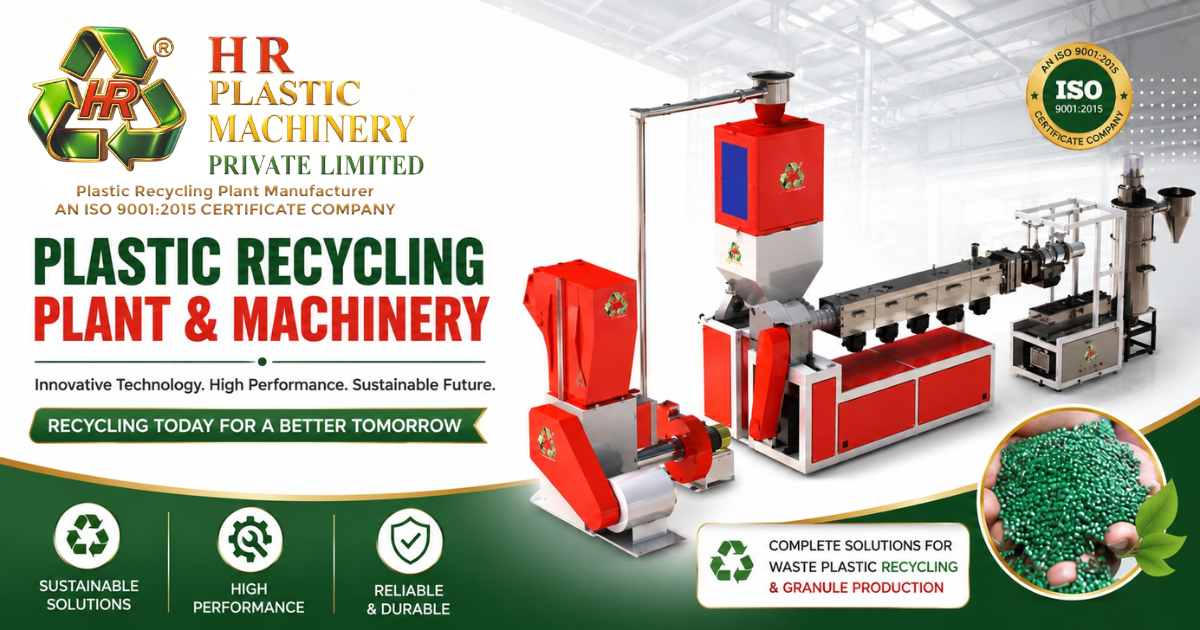
An HDPE recycling plant follows a staged flow: sorting, size reduction, label and metal removal, hot and cold washing, high-speed drying, agglomeration where needed, extruder with vacuum degassing, melt filtration, pelletising, and silo bagging. Density separation improves purity; inline MFI checks stabilise downstream moulding. PLC/SCADA recipes govern zone temperatures, screen-changer timing, and feed rates, while water-treatment modules recycle process water. Before commissioning, vendors run FATs to validate throughput and kWh/kg targets. See a typical layout and upgrade options on HR Plastic India.
Types of HDPE Recycling Plants
- Compact 150–300 kg/hr lines for MSMEs and municipal MRFs, ideal for decentralised operations and frequent scrap variability.
- Midscale 400–800 kg/hr plants with forced-feed extruders, friction washers, and die-face cutters for caps, crates, and blow-moulded waste.
- High-throughput 1000–1500 kg/hr twin lines enabling redundancy, longer runs, and minimal changeovers for contract granule production.
- Food-contact rHDPE configurations with SS304 contact parts, advanced filtration, and odour control for detergent, dairy, and FMCG applications.
- Turnkey retrofits for legacy plants: SCADA integration, water-recycling skids, bolt-on capacity modules, and better guarding for operator safety.
Key Features and Specifications of HDPE Recycling Plants
- VFD-driven motors with documented kWh/kg benchmarks for predictable operating costs and energy-efficiency audits.
- Automatic screen changers, multi-zone heating, and vacuum degassing deliver cleaner melt with fewer black specks.
- SS304 wetted parts in wash lines and piping, improving hygiene, corrosion resistance, and long-term durability.
- PLC/SCADA with alarms, recipe control, preventive maintenance prompts, remote diagnostics, and production reporting dashboards.
- Modular spares and nationwide service coverage reduce downtime and simplify inventory planning for continuous operations.
Applications of HDPE Recycling in India
- Blow-moulders convert rHDPE into drums, jerrycans, and lubricant containers, demanding consistent MFI, odour control, and impact strength. Plants supplying these segments must document colour stability, contamination thresholds, and traceable batches for repeat orders across India.
- Injection moulders use rHDPE for crates, caps, bins, and pallets in logistics and retail. They require uniform granule size, moisture control, and filtration levels that protect tools, reduce rejections, and stabilise cycle times.
- Pipe manufacturers blend rHDPE for corrugated drains and cable-protection conduits, targeting ring stiffness and environmental stress crack resistance. Plants must ensure metal removal, controlled MFI, and colour consistency compatible with downstream co-extrusion lines.
- Municipal and industrial waste managers valorise HDPE caps, canisters, and household containers, diverting volumes from landfills. Reliable washing and efficient melt filtration create saleable pellets that support EPR targets and regional circular-economy goals.
Benefits of Choosing a Nearby HDPE Recycling Plant Manufacturer
- Lower lifecycle costs through dependable recycled feedstock, reduced virgin consumption, and predictable kWh/kg; plus nearby service reduces downtime, travel charges, and lead times, improving payback for MSMEs and large enterprises operating multi-shift schedules.
- Improved product quality via hot washing, multi-stage filtration, vacuum degassing, and inline MFI checks; consistency cuts rejections, stabilises moulding parameters, and enhances brand confidence for automotive, packaging, and appliance segments.
- Stronger compliance posture with safety guarding, operator training, effluent control, and data logging for audits; supports EPR filings, customer assessments, and ESG disclosures aligned to Indian standards and multinational procurement frameworks.
- Operational reliability through recipe control, preventive maintenance prompts, and standardised spares; pan-India support shortens response times, while modular expansions let you grow capacity without major rebuilds or extended shutdowns.
Manufacturers & Suppliers in India
India hosts a mature ecosystem of HDPE recycling plant manufacturers and integrators serving MSMEs and large processors. When comparing partners, prioritise experience with your scrap mix, documented washing chemistry, filtration strategy, and proven kWh/kg. Reputable vendors typically deliver 2D/3D layouts, utility lists, commissioning, operator training, and spare-parts kits. Many maintain service hubs around Ahmedabad, Mumbai, Delhi-NCR, Coimbatore, and Hyderabad, enabling faster callouts. Optional upgrades include SS304 contact parts, SCADA dashboards, water-recycling skids, odour-control modules, and inline quality checks. Evaluate FAT protocols, warranty terms, response-time SLAs, and performance guarantees tied to throughput, moisture, and contamination limits before finalising contracts.
Maintenance and Safety Tips
- Inspect knives, screens, belts, and bearings daily; log vibrations, temperatures, and unusual noises.
- Clean tanks, pipes, and nozzles routinely; maintain wash chemistry and replace contaminated process water.
- Verify extruder pressures, heater zones, and target MFI; calibrate sensors and load cells periodically.
- Train operators on lockout-tagout, hot surfaces, confined spaces, PPE usage, and emergency procedures.
- Stock critical spares—heaters, thermocouples, seals, and screens—kept labelled, dry, climate-controlled, and easily accessible.
FAQs – HDPE Recycling Plant Manufacturer Near Me
1. How do I estimate the right capacity for my HDPE recycling plant?
+
Estimate using consistent scrap availability, planned shifts, and target customers. Consider contamination, moisture, and product mix. Request vendor trials with your scrap and insist on documented kWh/kg and MFI stability.
2. Can one line handle mixed caps, crates, drums, and household HDPE effectively?
+
Yes, with proper sorting, density separation, and staged filtration. However, to maintain stable quality, operators often run separate recipes or loops for difficult scrap, colours, and heavily contaminated streams.
3. What utilities are typical for a mid-size HDPE recycling plant?
+
Expect three-phase power, compressed air, and process water for washing and cooling. Budget for water-recycling, effluent treatment, and backup power to stabilise operations during grid fluctuations and monsoon interruptions.
4. How can we achieve odour-controlled, food-contact rHDPE consistently?
+
Use hot caustic washing, multi-stage filtration, vacuum degassing, and stainless contact parts. Maintain traceability, sample retention, and migration testing with accredited labs to satisfy brand requirements and regulatory audits.
5. What after-sales support should be included in my contract?
+
Installation, commissioning, operator training, preventive maintenance schedules, remote diagnostics, and guaranteed spares. Define response-time SLAs, warranty terms, and performance guarantees tied to throughput, moisture, contamination levels, and pellet quality metrics.
Contact Details
Talk to our specialists today for tailored solutions and fast assistance.
Company: Hr Plastic India
Phone: +91 95102-05025
WhatsApp: Chat on WhatsApp
Email: [email protected]
Website: www.hrplasticindia.com
Address: Office Address :- 3, Abhishree Industrial Park, B/h. G.V.M.M., Near Odhav Circle, Ahmedabad-382415.
Recent Posts