H.R. PLASTIC MACHINERY PVT. LTD.
Mother Baby Extruder Machine Manufacturer

Mother Baby Extruder Machine Manufacturer
Mother Baby Extruder Machine Manufacturer in India | Two-Stage Plastic Recycling Line
Mother Baby Extruder Machine Manufacturer
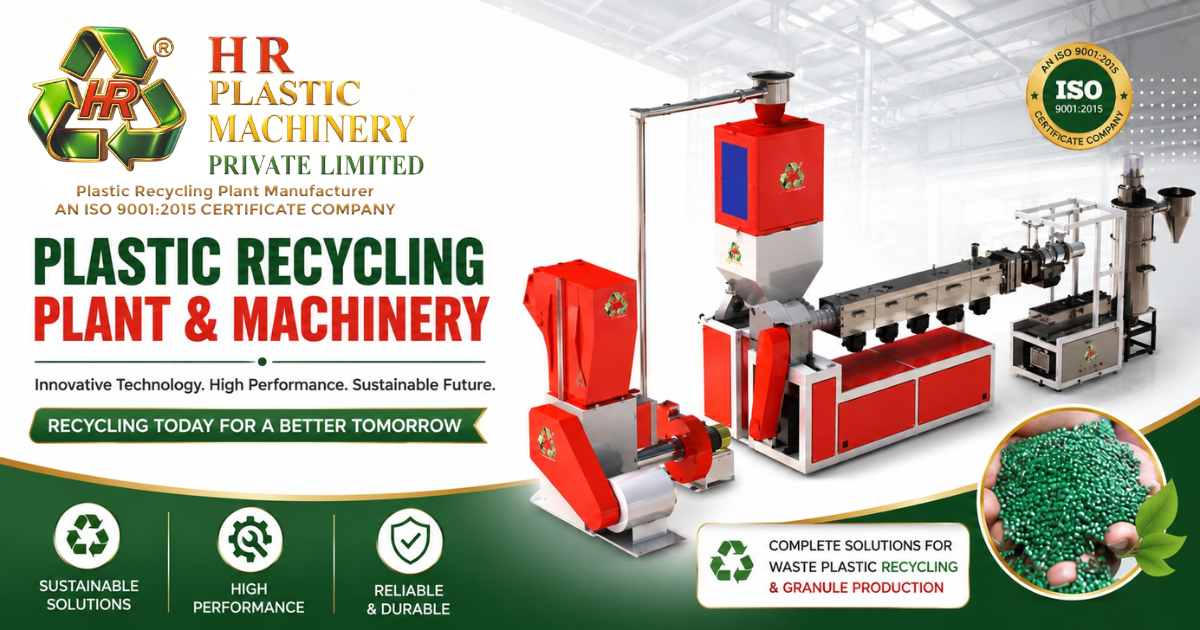
A mother baby extruder is a proven two-stage recycling line designed for heavily printed films, foamed plastics, and high-moisture or high-ink scrap. The first stage (mother) compacts, degasses, and filters the melt; the second stage (baby) stabilizes pressure and pelletizes with excellent shape consistency. As a manufacturer in India, we engineer lines around your polymer mix, MFI targets, and utilities to deliver steady output, low gels, and predictable kWh/kg across demanding production schedules.
Working Principle and Process Flow of Mother Baby Extruder
The process begins with feeding and thermal compaction in the mother extruder, where intensive venting and multi-stage filtration remove volatiles and inks. The melt is then transferred through a pressure-stabilizing adapter into the baby extruder for final homogenization and pelletizing via die-face or strand systems. Vacuum ports, screen changers, and recipe-driven temperature profiles ensure stable rheology and colour. For application notes and videos, explore hrplasticindia.com.
Types of Mother Baby Extruder Lines
- Compact two-stage lines for 150–300 kg/hr with integrated agglomeration and basic vacuum for mono-material post-industrial films.
- Mid-capacity systems for 400–800 kg/hr featuring continuous screen changers, twin venting, and auto dosing for inks and fillers.
- High-throughput 1000–1500 kg/hr lines with double filtration, gear pump stabilization, and die-face cutting for thin flexible packaging mixes.
- Dedicated rPET flake to pellet configurations with SS304 contact parts, hot-wash compatibility, and IV-protection strategies.
- Rigid regrind variants for HDPE and PP drums or crates with strong mixing sections and metal separation at the intake.
Key Features and Specifications
- Mother extruder with deep vacuum and vented screw design to reduce odour and moisture; baby extruder for final melt quality.
- Automatic or continuous screen changers, gear pump, and multi-zone heating to control pressure ripple and reduce gels.
- Die-face or strand pelletizer options with air or water ring cooling for uniform pellets and improved downstream conveying.
- Energy-optimized motors on VFD and documented kWh/kg benchmarks for audits and cost planning.
- PLC-SCADA with recipe control, alarm history, preventive maintenance prompts, and remote diagnostics.
Applications of Mother Baby Extruder in India
- Recycling of printed LDPE and LLDPE film from flexible packaging convertors into consistent pellets for blown film and lamination.
- Post-consumer carry bags and municipal film waste upgraded into pellets for garbage bags, liners, and agricultural films.
- HDPE and PP regrind from crates and drums stabilized for injection moulding of industrial parts and non-critical housings.
- rPET flake conditioning for strapping, fibre, and sheet where IV retention, moisture control, and colour stability are crucial.
Benefits of Choosing a Mother Baby Extruder Machine Manufacturer
- Superior de-inking and degassing performance for printed films, yielding cleaner melt, fewer black specs, and smooth surface finish.
- Stable throughput with pressure homogenization between stages, minimizing die surges and improving pellet geometry.
- Lower operating cost per kilogram via efficient drives, heat management, and optimized filtration change intervals.
- Stronger compliance with traceability data, EPR alignment, and machine guarding for audits and safety norms.
Manufacturers & Suppliers in India
India’s ecosystem offers experienced two-stage extruder manufacturers who tailor screws, L/D ratios, and filtration to local scrap characteristics. Deliverables typically include layout engineering, installation and commissioning, operator training, and spare parts kits. Popular upgrades are stainless contact parts, double-vent screws, gear pumps, water recycling for pelletizing, and odour control modules. Evaluate partners on demonstrated kWh/kg, melt filtration fineness, and service response across regions such as Ahmedabad, Mumbai, Delhi-NCR, Coimbatore, and Hyderabad.
Maintenance and Safety Tips
- Track barrel zone temperatures, motor load, and vacuum levels; investigate deviations before quality drifts appear.
- Maintain screen stock and follow changeover SOPs to avoid pressure spikes and gel formation.
- Clean die, cutter, and water system routinely to keep pellet shape uniform and reduce tails.
- Inspect bearings, heaters, thermocouples, and seals; log vibration or unusual noise for predictive maintenance.
- Train teams on lockout-tagout, hot surfaces, and confined spaces; review emergency stop response quarterly.
FAQs – Mother Baby Extruder Machine
1. When should I prefer a mother baby extruder over a single-stage line?
+
Choose two-stage for highly printed films, moisture-laden flakes, or mixed streams that need intensive venting and double filtration to hit product specs consistently.
2. What filtration level is recommended for flexible packaging waste?
+
A coarse screen in the mother stage with a finer screen or continuous changer in the baby stage balances pressure stability with low gel count; exact mesh depends on end-use and ink load.
3. Which pelletizer should I select?
+
Die-face pelletizing offers compact layout and smooth pellets for films; strand pelletizing is versatile and simpler to service. Selection depends on polymer, throughput, and water handling preference.
4. How do I size the line for my scrap availability?
+
Base capacity on steady scrap inflow, planned shifts, moisture and contamination levels, and downstream demand. Modular add-ons allow stepwise expansion without compromising melt quality.
5. What utilities are typical for a mid-size two-stage plant?
+
Three-phase power, process water for pelletizing and cooling, and compressed air. Include water recycling, ETP, and power backup to manage seasonal or grid variability.
Contact Details
Talk to our specialists today for tailored solutions and fast assistance.
Company: Hr Plastic India
Phone: +91 95102-05025
WhatsApp: Chat on WhatsApp
Email: [email protected]
Website: www.hrplasticindia.com
Address: Office Address :- 3, Abhishree Industrial Park, B/h. G.V.M.M., Near Odhav Circle, Ahmedabad-382415.
Recent Posts