H.R. PLASTIC MACHINERY PVT. LTD.
Twin Stage Plastic Recycling Plant

Twin Stage Plastic Recycling Plant
Twin Stage Plastic Recycling Plant | Double Degassing Extruder Line India
Twin Stage Plastic Recycling Plant
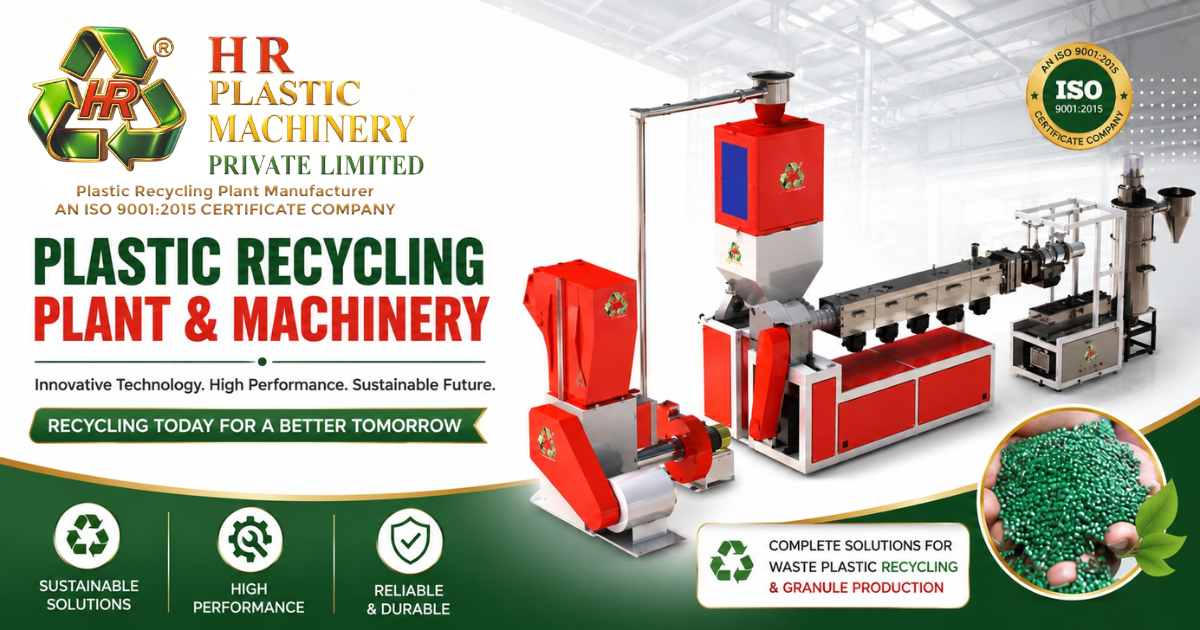
A twin stage plastic recycling plant uses a two-in-one extruder configuration with double melt filtration and dual vacuum degassing to convert highly contaminated films, woven sacks, raffia, and post-consumer plastics into stable, high-quality granules. The first stage handles heavy contamination and moisture; the second stage refines melt quality, ensuring consistent MFI, color, and mechanical properties suited to converters across India.
Working Principle and Process Flow
Material passes through inspection and size reduction, then into an agglomerator or force feeder. The first-stage extruder performs intensive melting and primary degassing with coarse filtration. Melt is then transferred via a melt pump to the second-stage extruder where deep vacuum removes volatiles and odors, followed by fine filtration and die-face or strand pelletizing. SCADA-based logging tracks kWh/kg, output, and alarms for traceability. For product specifications and layout guidance, visit www.hrplasticindia.com.
Configurations Available
- Compact 150–300 kg/hr twin stage lines for decentralized scrap aggregators and MSME converters managing mixed film waste.
- Medium 400–800 kg/hr systems with force feeder, melt pump, and automatic screen changer for higher uptime.
- High-throughput 900–1500 kg/hr plants with dual vacuum vents, continuous screen changers, and online pellet quality monitoring.
- PET flake to pellet twin-stage variants with hot-wash integration, IV retention controls, and stainless steel wetted parts.
- Rigid plastics (HDPE/PP) adaptations with label removal, metal separation, and intensive washing prior to double filtration.
Key Features and Specifications
- Double degassing with high-vacuum vents on both stages to minimize odor and volatiles in post-consumer feeds.
- Primary and secondary filtration (e.g., 120–200 mesh) with automatic/continuous screen changers to reduce black specks.
- Energy-optimized drives with VFDs; documented kWh/kg benchmarks for predictable operating costs.
- Melt pump for pressure stability and uniform pellet geometry, improving downstream film and sheet processing.
- PLC/SCADA recipe control, alarm history, remote diagnostics, and preventive maintenance prompts.
Applications
- LDPE/LLDPE film granules for carry bags, liners, and blown film where consistent MFI, gel control, and printability are essential.
- PP raffia/PE woven sack recycling for tapes, ropes, and non-critical injection parts with improved tensile and elongation.
- HDPE regrind to pellets for drums, crates, conduits, and blow moulding where dimensional stability matters.
- rPET pellets for fibers, straps, and non-food packaging with hot-wash and IV management for color and strength retention.
Benefits of Twin Stage Technology
- Higher melt purity through staged filtration and deep vacuum, reducing gels, odors, and contaminants in final granules.
- Stable production on mixed and high-moisture inputs, enabling broader scrap sourcing and steady plant utilization.
- Improved pellet quality translates to fewer downstream rejections, smoother extrusion, and consistent film thickness.
- Lower lifecycle cost via energy optimization, standardized spares, and faster screen changes minimizing downtime.
Manufacturers & Suppliers in India
Indian manufacturers offer twin stage lines with modular upgrades such as stainless steel contact parts, water recycling units, odor control, and online pellet classifiers. Typical scope includes layout design, installation, commissioning, operator training, spare kits, and remote support. Service coverage across Ahmedabad, Mumbai, Delhi-NCR, Coimbatore, and Hyderabad is common. Evaluate performance guarantees tied to throughput, contamination limits, and pellet quality before order finalization.
Maintenance and Safety Tips
- Track vacuum levels on both stages; investigate sudden drops indicating seal or vent blockages.
- Inspect screen changer seals, breaker plates, and heaters; maintain spare mesh inventories with traceable part codes.
- Monitor melt pressure and temperature trends; calibrate sensors and load cells per planned schedules.
- Clean hot-wash tanks, piping, and centrifuges; maintain chemistry strength and replace fouled water routinely.
- Train operators on lockout-tagout, high-temperature zones, nip points, and emergency stop procedures.
FAQs – Twin Stage Plastic Recycling Plant
1. When should I choose twin stage over single stage?
+
Select twin stage for high-contamination, high-moisture inputs (post-consumer films, woven sacks). Double degassing and staged filtration deliver cleaner melt and better odor control than single stage lines.
2. What utilities are required for a mid-size plant?
+
Three-phase power, process water for washing/cooling, and compressed air. Provision for water recycling, ETP, and gensets helps stabilize operations during grid fluctuations and monsoon seasons.
3. Which pelletizing method is recommended?
+
Die-face pelletizing is compact and suited to films; strand pelletizing offers easier color changes and simple maintenance. Choose based on polymer, output targets, and downstream needs.
4. How do I ensure consistent MFI and color?
+
Use controlled feeding, melt pump stabilization, dual filtration, and proper vacuum levels. Maintain segregation of input streams and monitor lab data for MFI, color L*a*b*, and moisture.
5. What should be included in after-sales support?
+
Installation, commissioning, operator training, preventive maintenance schedules, remote diagnostics, guaranteed spares, and response time commitments tied to uptime KPIs.
Contact Details
Talk to our specialists today for tailored solutions and fast assistance.
Company: Hr Plastic India
Phone: +91 95102-05025
WhatsApp: Chat on WhatsApp
Email: [email protected]
Website: www.hrplasticindia.com
Address: Office Address :- 3, Abhishree Industrial Park, B/h. G.V.M.M., Near Odhav Circle, Ahmedabad-382415.
Recent Posts