H.R. PLASTIC MACHINERY PVT. LTD.
Automatic Washing Plant in Gujarat
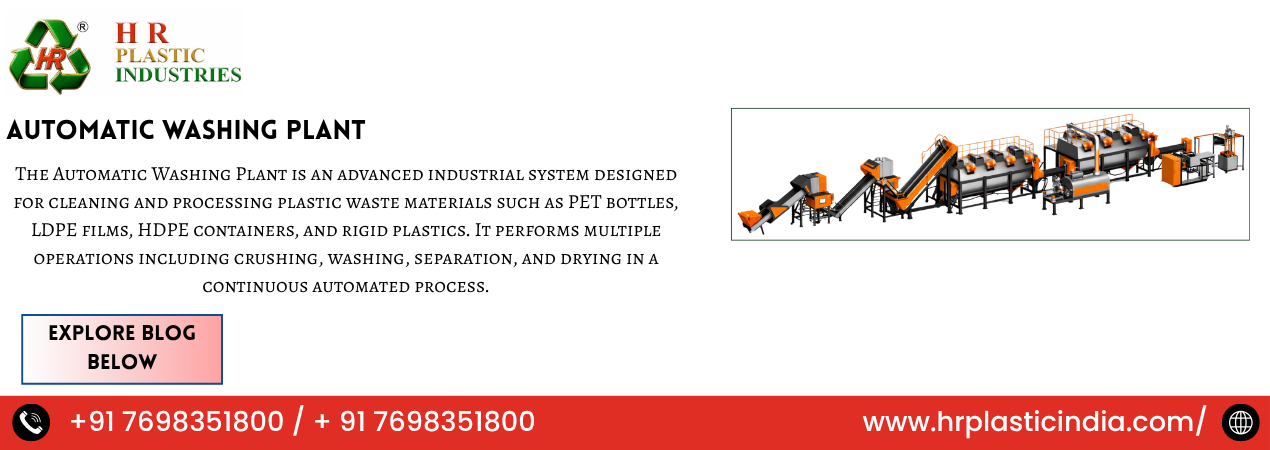
Automatic Washing Plant in Gujarat
Automatic Washing Plant in Gujarat | HR Plastic Industries
Industrial Cleaning Solutions · Gujarat
Automatic Washing Plant
Automatic Washing Plant
in Gujarat
Industrial cleaning has become a critical process across manufacturing sectors, where component precision, contamination control, and surface cleanliness directly influence product quality.
Automatic Washing Plant in Gujarat
Demand for Automatic Washing Plant in Gujarat has grown steadily as industries seek reliable systems that improve cleaning consistency while reducing manual intervention.
An automatic washing plant is designed to clean industrial components, fabricated parts, assemblies, and production equipment through controlled washing cycles. These systems are commonly used to remove oil, grease, coolant residue, dust, metal chips, and process contaminants from components before assembly, coating, inspection, or dispatch.
As Gujarat continues expanding across automotive, engineering, pharmaceuticals, food processing, and precision manufacturing sectors, industrial washing automation has become increasingly important. Manufacturers often require repeatable cleaning processes that support productivity, maintain hygiene standards where necessary, and reduce dependence on labor-intensive cleaning methods.
Understanding Automatic Washing Plant Systems
An automatic washing plant is an engineered cleaning system that uses programmed processes involving water, detergents, spray systems, immersion methods, pressure cleaning, or multi-stage treatment to clean components efficiently.
Unlike manual washing methods, automated systems help control variables such as temperature, pressure, chemical concentration, cycle duration, and drying parameters. This improves cleaning repeatability while supporting greater process standardization.
Depending on industrial applications, these plants may incorporate washing, rinsing, drying, filtration, recirculation, and component handling functions within a single integrated system. Their configuration often depends on part geometry, contamination type, throughput requirements, and applicable industry standards.
Why Industrial Demand Is Growing in Gujarat
Gujarat has a strong industrial ecosystem that includes engineering clusters, chemical processing, automotive production, fabrication units, and export-oriented manufacturing. In these environments, cleaning is not merely a support activity but often a quality-critical process.
Automatic washing plants help manufacturers address several practical requirements:
- Removal of machining oils and process contaminants
- Improved pre-assembly cleaning consistency
- Better surface preparation before coating or treatment
- Reduced dependence on manual cleaning
- Improved production flow and repeatability
These operational advantages have increased adoption across both large-scale manufacturers and specialized production facilities.
How an Automatic Washing Plant Works
Most automatic washing systems operate through a sequence-based process in which components move through controlled cleaning stages. Although configurations vary, the process generally includes loading, washing, rinsing, drying, and unloading.
The washing stage may use spray jets, immersion systems, ultrasonic action, or rotary mechanisms depending on cleaning requirements. High-pressure sprays often help remove stubborn residues, while filtration systems assist in maintaining cleaning solution quality throughout operation.
Drying stages may include hot air circulation, blow-off systems, or moisture removal processes to prepare components for downstream operations. In advanced systems, programmable controls help optimize cleaning cycles for different products and contamination levels.
This automation improves process control while reducing variation associated with manual methods.
Types of Automatic Washing Plants Used in Industry
Different industries use different washing plant configurations depending on process needs. Common system types include:
- Conveyorized washing plants for continuous production lines
- Rotary basket washing systems for machined components
- Multi-stage component washing plants with rinse and dry modules
- Ultrasonic washing systems for precision cleaning applications
- Cabinet-type automatic washing plants for batch operations
- Customized washing plants for specialized industrial processes
Selection depends largely on contamination type, production volume, component complexity, and required cleanliness standards.
Key Features Considered in Automatic Washing Plants
Industrial buyers often evaluate washing plants based on operational performance, reliability, and process suitability rather than equipment size alone.
Important features commonly considered include:
- Automated control systems for cycle management
- Multi-stage cleaning and drying capability
- Chemical dosing and filtration integration
- Temperature and pressure control systems
- Energy and water efficiency provisions
- Stainless steel construction for durability
- Easy maintenance access and serviceability
These factors often influence long-term operating performance and process efficiency.
Applications Across Industries
Automatic washing plants support a wide range of industrial applications where cleanliness affects product quality, performance, or compliance.
Typical applications include:
- Automotive components cleaning
- Precision engineering parts washing
- Pharmaceutical equipment cleaning
- Food processing equipment washing
- Fabricated metal component cleaning
- Hydraulic and mechanical assembly cleaning
- Surface preparation before coating or plating
Because cleaning requirements vary significantly across industries, many systems are designed around specific application needs.
Benefits of Automated Washing Over Manual Cleaning
Manual cleaning methods may suit limited tasks, but automated washing systems offer process-level advantages for industrial operations.
Key benefits often include:
- Improved cleaning consistency
- Higher productivity and reduced cycle variability
- Better contamination control
- Reduced labor dependency
- Lower rework related to improper cleaning
- Enhanced process repeatability
- Support for standardized quality procedures
For manufacturers focused on operational efficiency, these factors often justify investment in automated systems.
Factors to Consider Before Selecting an Automatic Washing Plant
Selecting the right system typically requires evaluating process requirements rather than choosing only by capacity or machine configuration.
A practical evaluation often includes component size, contamination type, cleaning chemistry compatibility, production volume, required cycle time, and drying expectations.
Buyers also commonly review whether the plant supports future expansion, automation integration, and maintenance accessibility. Utility requirements such as power, water, air, and drainage may also influence selection decisions.
Where regulatory or cleanliness standards apply, compliance requirements can become an important consideration during system specification.
Role of Automation in Modern Cleaning Processes
Industrial automation has transformed many support processes, including component cleaning. Automatic washing plants increasingly integrate programmable logic controls, sensors, filtration monitoring, and process controls that improve both performance and traceability.
In some advanced environments, automated washing systems form part of broader production automation by connecting with loading systems, conveyors, robotics, or inspection stages.
This integration helps align cleaning operations with modern manufacturing expectations focused on efficiency, consistency, and reduced process variation.
Why Process-Specific Design Matters
Not all components require the same cleaning method. Small precision parts may require different washing mechanisms than fabricated assemblies or heavy industrial components.
Process-specific design often considers:
- Material compatibility
- Surface finish sensitivity
- Residue type and removal complexity
- Throughput requirements
- Required drying level
- Industry-specific hygiene or cleanliness standards
This is why customized or application-driven system design often becomes important in industrial washing projects.
Automatic Washing Plant Demand in Gujarat's Manufacturing Sector
Industrial growth across Gujarat has contributed to wider adoption of automated cleaning technologies. As manufacturers pursue productivity improvements and stricter quality controls, washing automation has shifted from optional equipment to a process necessity in many sectors.
Whether used in automotive clusters, engineering units, pharmaceuticals, or process manufacturing facilities, automatic washing plants support operational reliability by improving cleaning quality and workflow efficiency.
Their role continues to expand as industries prioritize automation, repeatability, and process-controlled manufacturing practices.
Frequently Asked Questions
What is an automatic washing plant used for?
An automatic washing plant is used for cleaning industrial components, assemblies, tools, or equipment by removing oil, dust, machining residue, and contaminants through automated washing cycles. It supports consistent and efficient industrial cleaning.
Which industries use automatic washing plants?
These systems are widely used in automotive, engineering, pharmaceuticals, food processing, fabrication, and precision manufacturing industries where controlled cleaning is important for product quality and process reliability.
How is an automatic washing plant different from manual cleaning?
Unlike manual cleaning, automated washing systems control cleaning variables such as pressure, temperature, chemistry, and cycle timing. This improves consistency, reduces process variation, and supports higher productivity.
Can washing plants be customized for specific components?
Yes, many automatic washing plants are designed according to part size, contamination type, production volume, and required cleaning standards. Custom configurations are common in industrial applications.
Do automatic washing plants include drying systems?
Many industrial washing plants include integrated drying systems such as hot air drying, blow-off modules, or multi-stage drying processes depending on application requirements.
What factors matter when choosing an automatic washing plant?
Important factors include component type, contamination level, throughput needs, cleaning method, drying requirements, utility availability, maintenance access, and overall process compatibility.
Recent Posts